Community Organizing: How to Turn Local Concerns Into Collective Action
U.S. community organizers can map residents and decision-makers, then use neighborhood associations, school boards, city councils, county offices, public hearings, and local service channels as appropriate. Confirm which body controls the issue; a meeting or petition does not itself authorize a budget or service change.
What Is Community Organizing?
Community organizing is the process of bringing people affected by a shared issue together to build leadership, coordinate resources, influence decision-makers, and pursue community-defined goals. It combines relational organizing, grassroots leadership development, strategic planning, and collective action. Its durable product is not only a policy win or a completed project: it is a community with stronger relationships and greater capacity to act again.
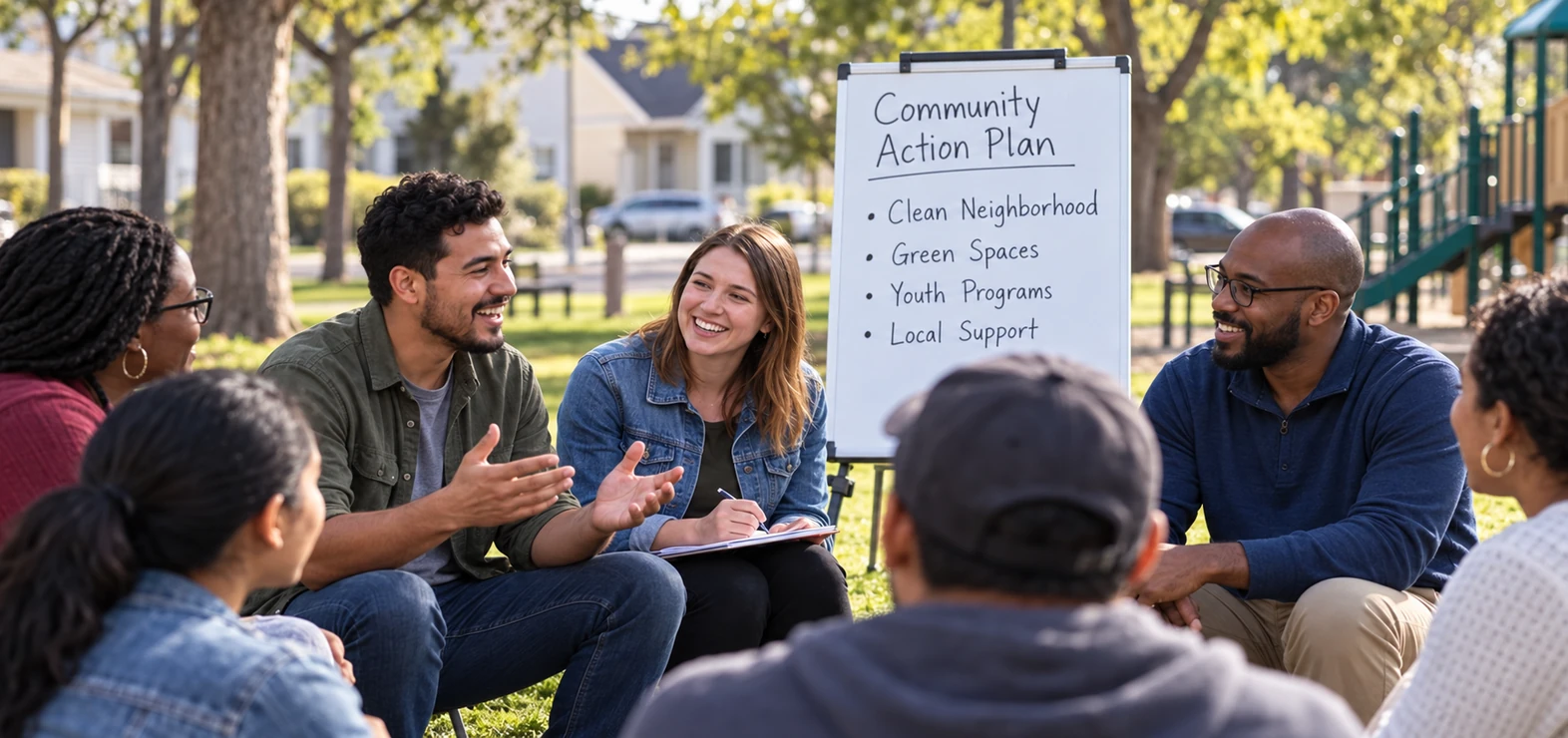
An organizer should not claim to represent everyone. Listening to residents, introducing neighbors to one another, and helping new leaders take responsibility matter more than speaking on their behalf.
Is Organizing the Right Approach?
Choose community organizing when a problem is shared, the people affected can participate, and change requires coordinated influence or sustained cooperation. For an immediate emergency, emergency response and direct assistance take priority. For an individual administrative error, a complaint or legal aid may be more appropriate. For a one-off cleanup, volunteer mobilization may be sufficient; organizing becomes valuable when residents also need to change the system that causes the waste to accumulate.
| Approach | Primary purpose | Best fit |
|---|---|---|
| Community organizing | Build a base, leaders, and collective power | Recurring problems requiring sustained change |
| Mobilization | Bring people to a specific action | Turnout for a meeting, petition, or event |
| Advocacy | Influence a policy or institutional decision | A defined rule, budget, or service decision |
| Community development | Improve local assets, services, and capabilities | Longer-term neighborhood improvement |
| Mutual aid | Share resources to meet immediate needs | Direct support during hardship |
A group may use several approaches at once. Residents might organize a leadership team, gather volunteers for a cleanup, and then press the responsible agency to fix recurring waste collection failures. The test is whether residents gain a say in decisions, rather than simply joining an event planned elsewhere.
How Community Organizing Works: From Listening to Leverage
1. Listen before selecting a campaign
Start with one-on-one meetings and community conversations, not a prewritten demand. Ask what has changed, who is affected, what residents have tried, and which improvement would matter most. Active listening uncovers shared interests as well as differences. A resident worried about drainage may care about school access; a street vendor may worry about losing customers during construction. Both perspectives belong in the issue assessment.

Sketch a relationship map showing trusted contacts, existing groups, and streets or households not yet heard from. Ask permission before saving phone numbers or sharing anyone’s details in a messaging group.
2. Define a specific, winnable issue
“Make the neighborhood safer” is a broad aspiration. “Secure a publicly announced repair schedule for the broken streetlights on two named roads” is a negotiable demand. State the problem, the responsible authority, the desired change, and a way to verify delivery. SMART goals can help, but avoid arbitrary deadlines if procurement or approvals are outside the group's control.
Distinguish an issue from a solution. Residents may agree that floodwater is a problem but disagree on whether drainage maintenance, waste management, or construction oversight is the cause. Verify the mechanism before campaigning for an intervention that may not work.
3. Build a constituency and leadership team
A petition signer is not necessarily a campaign member. Build a constituency by asking supporters to attend discussions, take responsibility for outreach, or help investigate the issue. Trusted neighbors, youth groups, faith communities, worker networks, and campus organizations may all help, but no single leader should be treated as the voice of the whole neighborhood.

Give the organizing committee named responsibilities: outreach, meeting facilitation, research, communications, volunteer coordination, and finances. Share those tasks so the campaign does not stop when one organizer is unavailable. New leaders may need practice with negotiation, facilitation, conflict resolution, and structured conversations.
4. Map power, stakeholders, and allies
Power mapping asks who has authority to make the requested decision, who influences that person, and which community assets can change the incentives. Separate the decision-maker from an intermediary: a neighborhood representative may convene a discussion without controlling a municipal budget.
| Actor | Question | Possible engagement |
|---|---|---|
| Decision-maker or target | Who can approve the change? | Formal meeting, documented request |
| Allies | Who shares the goal? | Coalition building and public support |
| Undecided stakeholders | What concerns prevent support? | Listening and evidence sharing |
| Opponents | What interests or constraints differ? | Negotiation and risk assessment |
| Constituency | Who bears the consequences? | Leadership and accountability |
U.S. community organizers can map residents and decision-makers, then use neighborhood associations, school boards, city councils, county offices, public hearings, and local service channels as appropriate. Confirm which body controls the issue; a meeting or petition does not itself authorize a budget or service change.
5. Choose tactics that match the decision
Match each tactic to the decision you want. A survey can establish how many households face a problem; photographs can document conditions; a meeting can obtain a response from the responsible agency. If those steps fail, residents may consider petitions, canvassing, letter writing, phone banking, demonstrations, or digital outreach, weighing the risks of each.
Public rallies, marches, and direct action can carry legal, safety, and reputational risks. Check applicable rules, accessibility, crowd safety, and participants' informed consent. A petition on Change.org can demonstrate interest, but signatures alone do not prove that a decision-maker has committed to act.
6. Negotiate, verify, and stay organized
Ask the decision-maker to specify the action, the person responsible, and the reporting date. Share meeting notes so residents can check the commitment. A crowded rally measures participation; a completed repair or service change measures an outcome. Keep the leadership team active after the first result.
A U.S. community-organizing scenario
Imagine residents of a densely populated neighborhood repeatedly experience standing water after heavy rain. A volunteer cleanup helps temporarily, but the problem returns. Rather than assuming a single cause, organizers interview households, map affected lanes, document dates and water levels, and ask local officials which drains or infrastructure are under their authority.

- Listening: Speak with households, renters, street vendors, and people with disabilities to understand different impacts.
- Shared demand: Agree on a request for an inspection, published findings, and a maintenance or repair plan.
- Power analysis: Identify the responsible local agency and possible allies, including neighborhood representatives and community organizations.
- Action: Submit evidence and request a meeting; use public outreach if needed and lawful.
- Verification: Track whether the inspection occurs, what actions are completed, and whether flooding changes during comparable rainfall.
This is a hypothetical U.S. example. Stormwater systems, rainfall, upstream development, and maintenance all affect flooding. Check whether conditions improve; completing an inspection or cleanup is not proof that flood risk has declined.
Which Organizing Model Fits Your Community?
Neighborhood organizing focuses on a place and shared local conditions. Issue-based organizing connects people around a specific concern, such as housing, transport, education, or environmental protection. Broad-based organizing builds coalitions across civic, religious, and other institutions. Social movement organizing connects local campaigns to wider demands for social justice or systemic change.
Faith-based organizing may draw on established relationships in religious communities, while preserving voluntary participation and respect for different beliefs. Labor organizing addresses workers' collective interests and may involve unions and workplace rights. Digital organizing uses messaging apps, online meetings, and social platforms to recruit, coordinate, and communicate; it is a channel rather than a substitute for trust.
Digital Organizing Without Excluding People
Opt-in text-message groups and social media can help neighbors coordinate, but a large group chat can conceal weak participation. Some residents share phones, have limited data, or prefer to speak in person. Keep notice boards, home visits, and accessible meetings alongside digital updates.

Ask before adding anyone to a chat or sharing their photograph. Limit access to contact lists, assign a moderator, and correct false information with a sourced update. Count the conversations and decisions that follow online outreach, not only views or likes.
Common Failure Modes and How to Avoid Them
Speaking for people who were never consulted
High turnout from one social network can hide missing voices. Check participation across affected streets, occupations, ages, and accessibility needs. Make meeting times and decision procedures transparent.
Confusing activity with influence
A busy calendar of rallies and petitions can conceal the absence of a viable decision pathway. Revisit the power map: does the target control the requested outcome, and what leverage can the constituency legitimately exercise?
Volunteer burnout and leadership bottlenecks
Repeated urgent requests exhaust a small core team. Set realistic volunteer shifts, create backup roles, celebrate completed milestones, and make it acceptable to decline tasks. Budget for transport, accessibility, printing, and childcare support where feasible.
Coalition conflict and unclear accountability
Coalitions often include groups with different priorities. Agree early on how demands are approved, who may speak publicly, how donations are handled, and how disputes are resolved. Publicly record financial decisions and avoid promising outcomes beyond the group's authority.
Assuming outside methods transfer unchanged
Measuring Whether Community Organizing Succeeds
Measure the changes the campaign is trying to produce, not whatever is easiest to count. Separate stronger relationships and leadership from official commitments and completed work.
| Dimension | Indicator | Guardrail |
|---|---|---|
| Relationships | Completed one-on-one conversations and follow-ups | Consent and representation |
| Leadership | New people independently facilitating or leading tasks | Workload and burnout |
| Participation | Returning participants and volunteer retention | Inclusion of less-connected residents |
| Influence | Decision-maker meetings and documented commitments | No false claim of official endorsement |
| Outcome | Completed repair, service change, or adopted policy | Independent verification and unintended effects |
Record the situation before the campaign: unresolved complaints, existing service schedules, or the condition of a road or drain. Check the same measures afterward. Weather, budget changes, elections, and other groups may also affect the result, so do not credit every improvement to the campaign.
A 30-Day Starting Plan
Days 1–7: Hold listening conversations, identify affected groups, and document competing explanations for the problem. Days 8–14: Convene an open discussion, select one issue, map stakeholders, and check who has formal authority. Days 15–21: Form a small leadership team, agree on a campaign goal, assign outreach and research tasks, and select a safe first tactic. Days 22–30: Make the first formal request or hold a community meeting, record the response, and set the next checkpoint.
The first month may establish contacts and responsibilities, but winning a campaign often takes longer. Where residents face retaliation or safety risks, check those risks before asking them to participate publicly.
Frequently Asked Questions
Yes. Small groups can start with conversations, donated meeting space, and volunteer time. Larger campaigns may require fundraising for transport, training, accessibility, communication, and legal advice. Keep a transparent campaign budget and clear donation records.
It often concerns decisions about resources and public services, but it does not have to support a political party. Groups can organize around nonpartisan local needs while respecting participants' different views and applicable laws.
There is no universal minimum. A small group of committed residents can begin listening and mapping relationships. The relevant test is whether it can reach people affected by the issue, share responsibility, and build sufficient influence for its goal.
An activist may focus on raising awareness or taking action on an issue. A community organizer concentrates on developing relationships, leaders, and a durable constituency capable of collective action. One person can do both.
Yes, but decision pathways and social relationships differ. Rural organizing may involve town or county government, farm and ranch communities, land use, or access to health care and public services; urban organizing may focus on housing, transit, flooding, or municipal infrastructure. In either case, verify local authority and ensure participation is genuinely voluntary.
Recommended Materials
Community Tool Box: community organization and change; Community Tool Box: facilitation skills; Community Tool Box: community advocacy
Invite affected neighbors to a listening conversation. Before naming a campaign target, check the problem together and ask who has not yet been heard.
Read Similar Articles

Case studies in how municipal communities coalesce around environmental, housing, and educational issues to demand accountability.
Learn More
Principles for designing lasting mutual aid projects, volunteer networks, and participatory community service programs.
Learn More